Information for teachers
Each book comprises eight activities where students apply their STEM knowledge and skills to propose solutions to real-world challenges informed by the United Nations Sustainable Development Goals (SDGs). Each activity focuses on a challenge that relates to one of the following SDG: Zero Hunger (Goal 2), Good Health and Well Being (Goal 3), Clean Water and Sanitation (Goal 5), Affordable and Clean Energy (Goal 7), Sustainable Cities and Communities (Goal 11), Climate Action (Goal 13), Life Below Water (Goal 14), and Life on Land (Goal 15). By engaging in each activity “hands-on”, students propose an idea for tackling the challenge. They propose their ideas at Grade 1 and 2 levels through their plans. The “creating” part is optional. However, as a teacher, you can decide whether students create a model as a solution to the challenge. While it is envisaged that students complete the activities in their workbooks individually, they will work in groups to develop/improve their ideas. As a teacher, you are encouraged to adjust the focus and the scope of activities to suit your context and learners’ needs.
The essence of integrated STEM education is project-based learning (PBL). It is a fun way for students to learn and for teachers to teach. Each activity’s real-world challenge is likely to interest, engage and enthuse students. The STEM PBL framework proposed by Forbes, Chandra, Pfeiffer and Sheffield (2020) was used to design the activities.
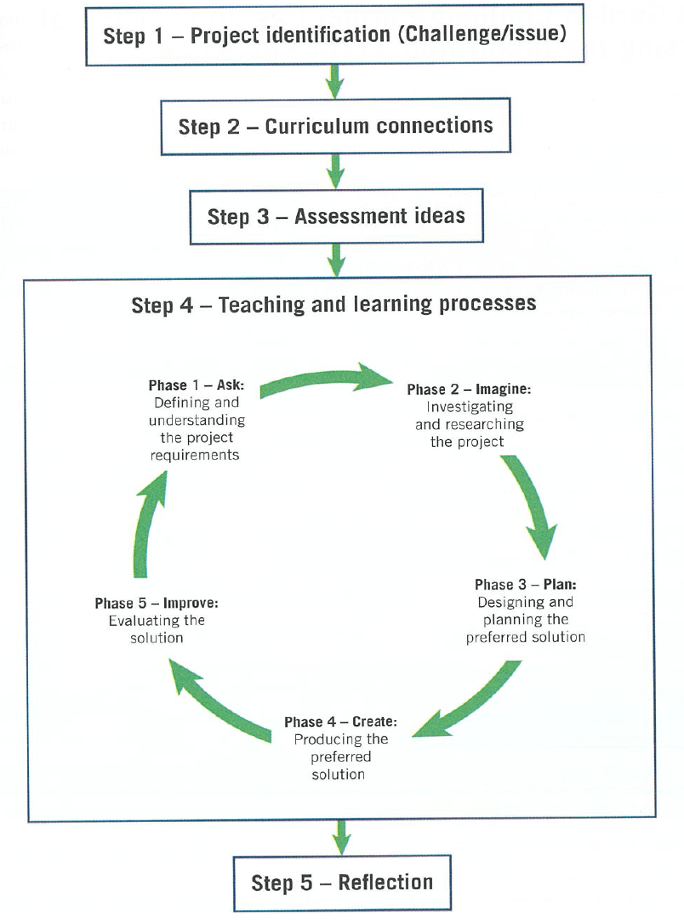
Students need to tackle each challenge through the following steps: Ask ➔ Imagine ➔ Plan ➔ Create ➔ Improve. Through these steps, students apply their design-thinking skills to propose solutions to real-world challenges. Workplace Health and Safety is an integral part of each activity. Students are expected to handle tools, equipment and materials with care. Teachers are also expected to reinforce using safety gear – that is, Personal Protective Equipment (PPE) as needed.
 My STEM Workbook