Thank you for your reviews. We value your feedback.The time and the thought that you have put into writing the reviews are truly appreciated.
Workbooks 1 and 2
This review is for Workbooks 1 and 2…The activities in the ‘My STEM Workbook’ series are carefully planned and thought out to maximise connections to the Australian curriculum for Science, Math, Design and Technology. With just the right amount of detail provided in each lesson, the workbooks are very user-friendly for teachers, in that they are not overwhelmingly in the information they provide, yet they also provide what is needed for a teacher to be able to effectively facilitate the activities. The helpful and aesthetic visuals contribute to the appeal of these workbooks, so any teacher of science or math seeking practical activities to supplement their lessons would be wise to consider using these books. Micheal
Workbook 3
I received this [My STEM Workbook 3] in the mail yesterday. I can see that we will use the Perma(-nent) (agri-)culture one straight away. I wish I had had the video game on plastic removal last term. These books are well set out and well thought through. I also like the overview of what ACARA content descriptor is used and the pages at the back on the properties of materials, etc. Although there are 3 books, one per age group, I think that with a few tweaks or additions, you can use all 3 for any age because of the clear process used.These are true design-thinking projects. It is beautifully laid out—not too much, not too little—and adheres to the United Nations’ goals. Well worth the reasonable money! Gabrielle
Workbook 1
My STEM Workbook 1 is a colourful, child-friendly book written simply, making it easy for beginners to read, learn, and do the Challenges.
On page 17, the student learns the name of the little cartoon character, Epi.
Epi travels through the book doing the challenges with the students.
As new words are introduced, they are written in BOLD print, so the young student can look at the back cover in the GLOSSARY to find the meaning of the new word. This is useful for all students, particularly those from non-English-speaking homes.
Workbook 1 contains eight challenges, during which the young students learn how to apply the different parts of STEM (Science, Technology, Engineering, and Mathematics) to appreciate and improve their environment and create new objects by using and recycling materials that they already have.
By using all the aspects of STEM, the student learns in Challenge 1 how to design and plant a vegetable garden to feed himself and encourage ZERO HUNGER in the world. Learning about composting teaches the student to reuse all of it to grow another garden.
Learning to make a healthy sandwich is Design, Technology, and Mathematics in Action in Challenge 2.
In Challenge 6, the students learn how to use Engineering to make their musical instrument by recycling an item that would otherwise be added to the rubbish heap.
All this and more! These ideas and lessons would be easy for young students to learn and would challenge them to think deeply about all aspects of STEM.
Class discussions are included and encouraged.
Teachers are always very busy and time-poor, so My STEM Workbook 1 would be handy as most of the preparation is already done and covers all aspects of the STEM programme for young students.
Mrs S
Workbook 2
My STEM Workbook 2 is the second of the My STEM Workbook trilogy by authors Vinesh Chandra and Basil Slynko and is a holistic approach for teaching STEM.
My STEM Workbook 2 is written for Primary 3-4 and is Australian Curriculum Version 9.
Like My STEM Workbook 1, My STEM Workbook 2 is colourfully engaging, with lots of illustrations and assorted challenges.
The little robot on the front cover suggests to the student that My STEM Workbook 2 is more technologically advanced than My STEM Workbook 1, and the student will not be disappointed.
There are 8 challenges in the workbook, each on colourfully sectioned pages, making it visually more interesting for the student.
Within each challenge, there are 5 challenge activities to ask, imagine, plan, create, improve, and then reflect. Individual, group, and class discussions are encouraged.
Within each of the 8 Challenges in My STEM Workbook 2, there is a choice of 3 helpful websites that not only the student can access to help complete these challenges, but also the teacher, either in the classroom situation or, in the homeschool environment, can access to help their students complete these challenges.
Ample room is given within the workbook for the student to write and draw their observations and solutions.
Many topics are covered where the student will use and learn all aspects of STEM, from designing and growing a successful herb garden (Zero Hunger Challenge 1) and how to deal with surplus crops, to how to fight infections and diseases in Challenge 2.
They will learn about Clean Water and Sanitation (Challenge 3) and where their water comes from, plus learn the important skill of learning to read a weather map.
Push or Pull? Find out in Challenge 4.
Building a model of a tiny house to scale will call on all their Science, Design and Technology, Engineering and Mathematics knowledge in Challenge 5 (Sustainable Cities and Communities). The student will learn the difference between natural and man-made materials, how to make their house visually appealing, and why build a tiny house compared to a regular house.
Learning about the effect of waste on our climate (Challenge 6 Climate Action) will teach and encourage recycling and upcycling of various urban waste items that are being thrown away into already overflowing rubbish dumps.
In Challenge 7 (Life Below Water), the students will learn how to make a digital book about organisms that live below the water.
Last, but not least, in Challenge 8 (Life on Land), the students will again use all their STEM skills to construct a model of a shelter for one of the best recyclers a person can have in their own back yard, chickens!
In Challenge 8, as in Challenge 1, the budding entrepreneurs will gladly call on their math skills to work out their profit from surplus stocks of eggs and herbs.
A glossary of new words is included on the back cover.
Fun puzzles are dotted throughout the My STEM Workbook 2 to challenge the students even further.
All this and more! So many fun ways for Years 3-4 to learn from My STEM Workbook 2.
I’m looking forward to what the authors will come up with in the third and final of the trilogy in My STEM Workbook 3.
Mrs S
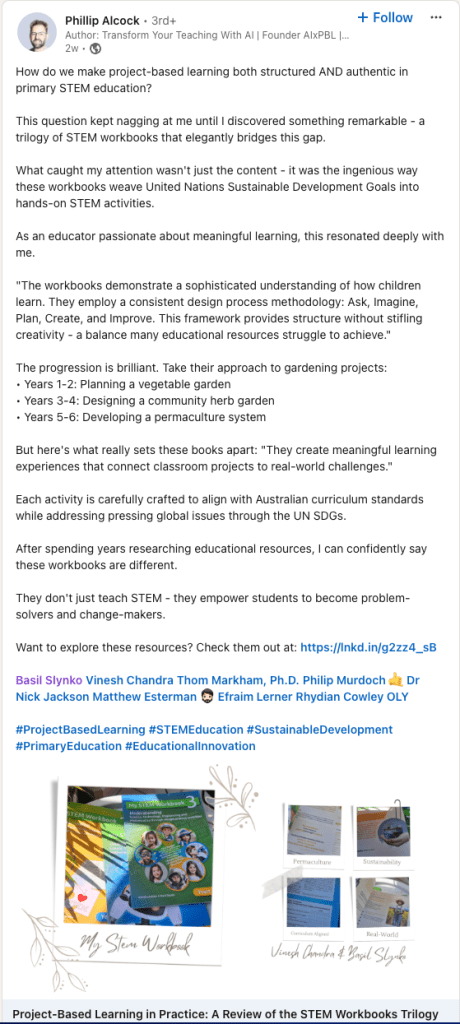
Click here to watch to Phillip Alcock’s review of the STEM workbooks on LinkedIn
Workbooks 1 and 2
My STEM Workbooks 1 and 2 are packed full of accessible and engaging activities. Combined with visually appealing graphics, the workbooks provide an outstanding introduction to all things STEM that will spark the imagination of young learners. Basil Slynko, also known as Professor Baz, brings years of experience both in the classroom and in the development of educational resources in the Design/STEM space to this series. Having worked with Basil in the school workshop, I have personally benefited from his design insights and expertise and know that young learners engaged in the My STEM activities will also. I particularly like the way the activities in this series tie into the United Nations Sustainable Development Goals. Not only will this series inspire young learners to be creative in the STEM space, it will also cause them to be mindful of the sustainability challenges facing their generation in the future. I highly recommend this series and look forward to the next installment for Years 5-6. Dr Carl W
We welcome your feedback. Please email your comments to: mystemworkbook@gmail.com
 My STEM Workbook